5 min read
Cappadocia’s Valleys on Horseback: A Day Among the Fairy Chimneys
From Çavuşin to Rose Valley, the ridges of Red Valley and on to Love Valley: the story of a ride, what you’ll see on each tour and tips for great photos from the saddle.
There are many ways to explore Cappadocia: by tour bus, on foot, by balloon or on an ATV. But if you want to feel the real rhythm of the valleys, the rhythm known to the people who have lived here for centuries, nothing beats moving slowly through them on horseback. In this post we’d like to take you, step by step, along a route that starts at our ranch.
Setting off from Çavuşin
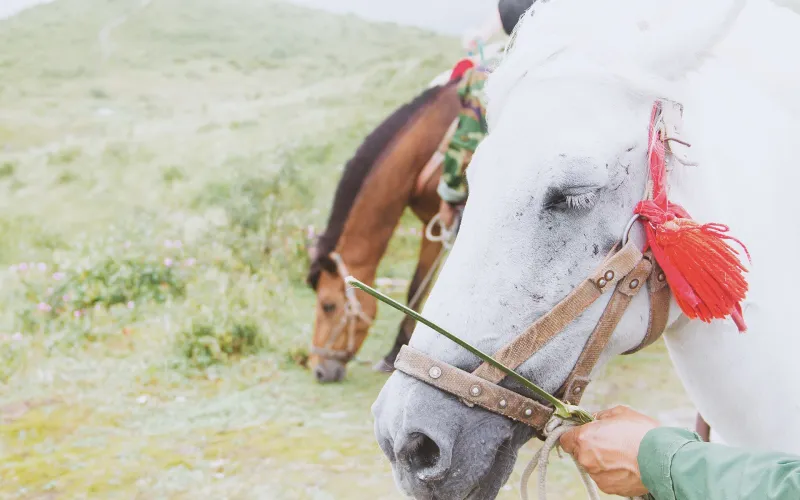
After putting on your helmet and meeting your horse at the ranch, you set off. In the first few minutes the old village of Çavuşin rises behind you: houses carved into the rock, arched doorways and, at the top, a huge rock that looks like a castle. The trail first winds through vineyards and apricot orchards. The ground is soft, the hoofbeats echo off the tuff, and if the day hasn’t warmed up yet, the air smells of wild thyme. Your guide deliberately keeps the pace slow on this first stretch, so you can get used to your horse and your horse can get used to you.
In the rocks along the trail you’ll notice rows of small, neat holes. These are pigeon houses. For centuries, villagers collected pigeon droppings to fertilise their vineyards and orchards, and that old tradition is part of the reason Cappadocia’s apricots and grapes taste so good.
Rose Valley: a valley of colours
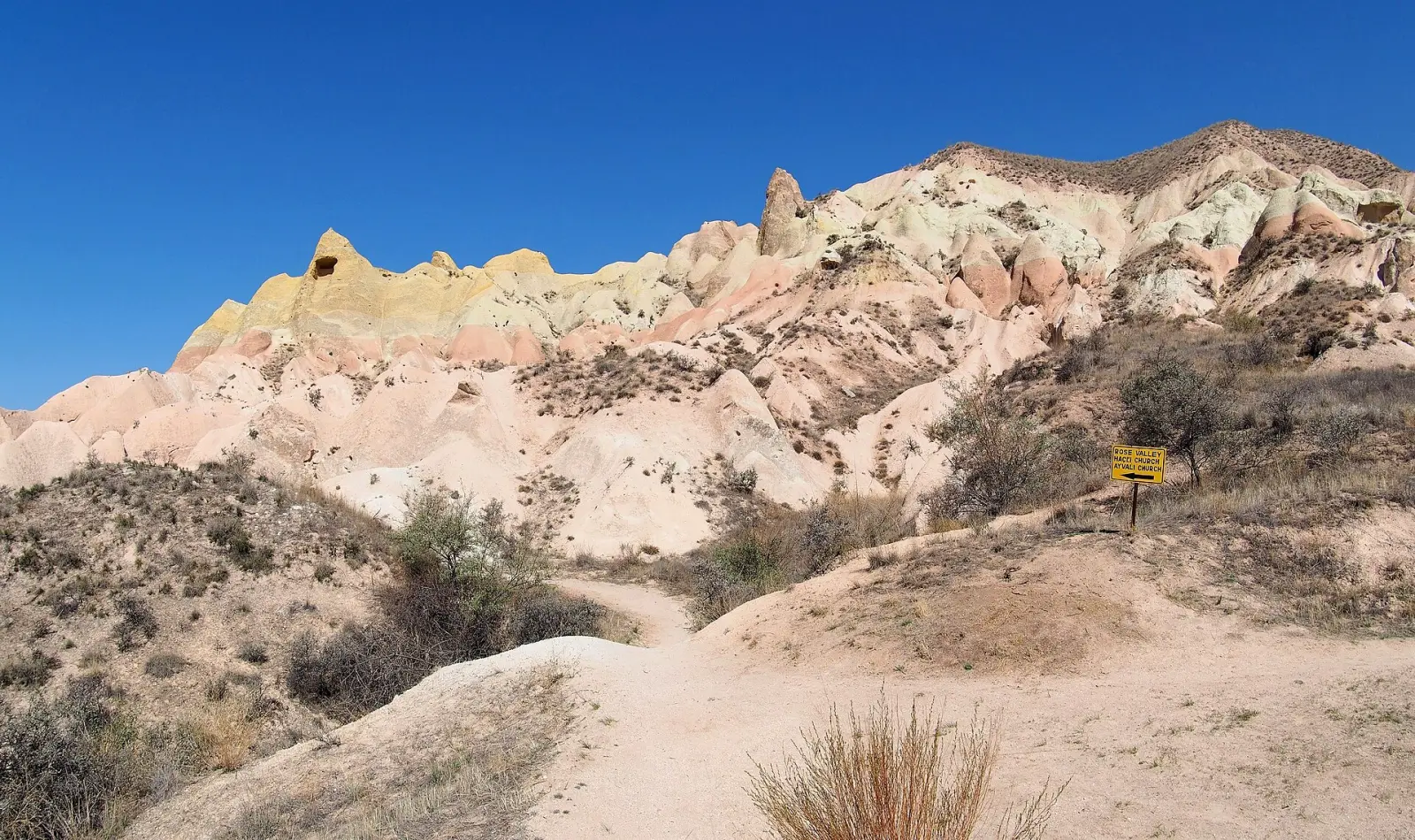
A few minutes later you reach the mouth of Rose Valley, and suddenly the landscape changes. The rocks ripple in layers of cream, pink and dusty rose, and the wind-carved ridges look like a frozen sea. The horses usually slow down here on their own, as if they want to take in the view too.
Deeper in the valley there are small churches carved into the rock. Some of these Byzantine chapels still have frescoes that have survived for more than a thousand years. Your guide tells you their story at suitable stops. Please don’t touch the frescoes; they belong to the generations after us as well.
The ridges of Red Valley
After Rose Valley, the trail climbs towards Red Valley. Its iron-rich tuff carries the red and copper tones that give the valley its name. Once you reach the ridge, the view opens up: Ortahisar Castle on one side, Çavuşin on the other and, on a clear day, the snowy peak of Mount Erciyes in the distance. This is the favourite photo stop on our two-hour ride. On the sunset ride, the horses rest here while you watch the sun go down behind the valleys.
Love Valley and Swords Valley
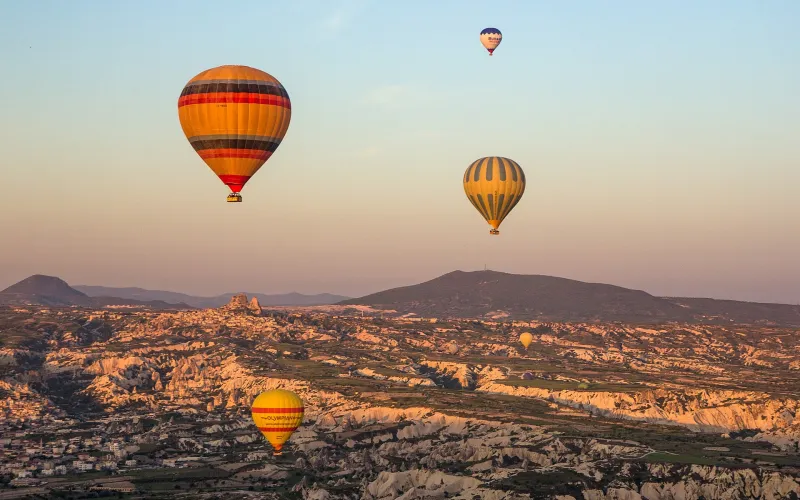
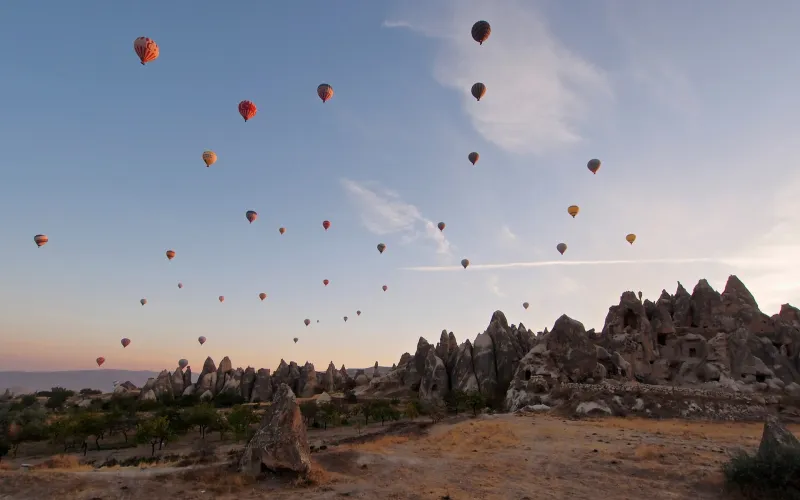
If you are ready for a longer adventure, our four-hour ride takes you over the sharp ridges of Swords Valley and on to Love Valley. Its tall, slender fairy chimneys make you feel small even from the saddle. In the early morning, balloons often float low over this valley; from horseback it feels as if you could reach out and touch them.
Why on horseback?
- Access: horses reach narrow trails and the depths of valleys that no vehicle can.
- Perspective: from the height of the saddle you see vineyards and valley floors you would miss on foot.
- Pace: a horse’s walk is exactly the right speed to take in the landscape.
- Quiet: no engines, so you pass through nature without disturbing it.
- Connection: a few hours with a horse often becomes the most personal memory of a trip.
What you’ll see on each ride
- 1-hour ride: the trails of Çavuşin and the mouth of Rose Valley.
- 2-hour ride: the full loop through Rose and Red valleys.
- Sunset ride: Rose and Red valleys with a sunset viewpoint.
- Sunrise ride: ridges with balloon views and Rose Valley in the morning light.
- 4-hour ride: Rose, Red, Swords and Love valleys.
Respecting the valleys
These valleys are not just scenery; they are also the vineyards, orchards and fields of families from Çavuşin, Göreme and Ortahisar. On horseback we stay on the trails and never ride across planted land. We greet the farmers we meet along the way, and more often than not they hand us a few apricots or a bunch of grapes. We leave no litter behind and never carve names into rocks or churches. The secret to Cappadocia surviving for thousands of years is the people who treat it with care.
We take the same care with our horses. In summer we rest in the shade during the hottest hours, avoid steep and slippery slopes, and keep track of how far each horse has travelled that day. If we notice a horse getting tired, we shorten the route.
Tips for photos from the saddle
- Only take photos at the stops, while the horse is standing still and both your hands are free.
- A shot framed between your horse’s ears makes one of the best souvenirs of Cappadocia.
- At sunset, keep the sun behind you; that is when the rocks glow most.
- Ask your guide to take a photo of you with your horse; they are always happy to.
For more about the valleys themselves, see our Cappadocia Valleys guide. Whenever you are ready to set off, our horses are waiting.